If you're down Castlegate way pop in and buy yourself something for tea. Footfall at Castle Market is down and rents are going up by 40%, the stallholders need the support of the city to fill the void the lack of Council input has left.

Saturday, 5 March 2011
Apples and Pears
Preparation for my next assessment has seen me spending a lot of time in Castle Market, Sheffield. And I've fallen in love with the place and the people who work there. I'll be posting the whole project at a later date but heres a few of the photos I've been taking.
Wednesday, 2 March 2011
Back in Time
This has nothing to do with Sheffield but is the most exciting photography project I think I've ever seen.
http://irinawerning.com/back-to-the-fut/back-to-the-future/
People return to the photographic poses they struck as a child.
Seriously gorgeous.
http://irinawerning.com/back-to-the-fut/back-to-the-future/
People return to the photographic poses they struck as a child.
Seriously gorgeous.
Sunday, 27 February 2011
Saturday, 26 February 2011
Human Nature
Ever wondered where you came from?
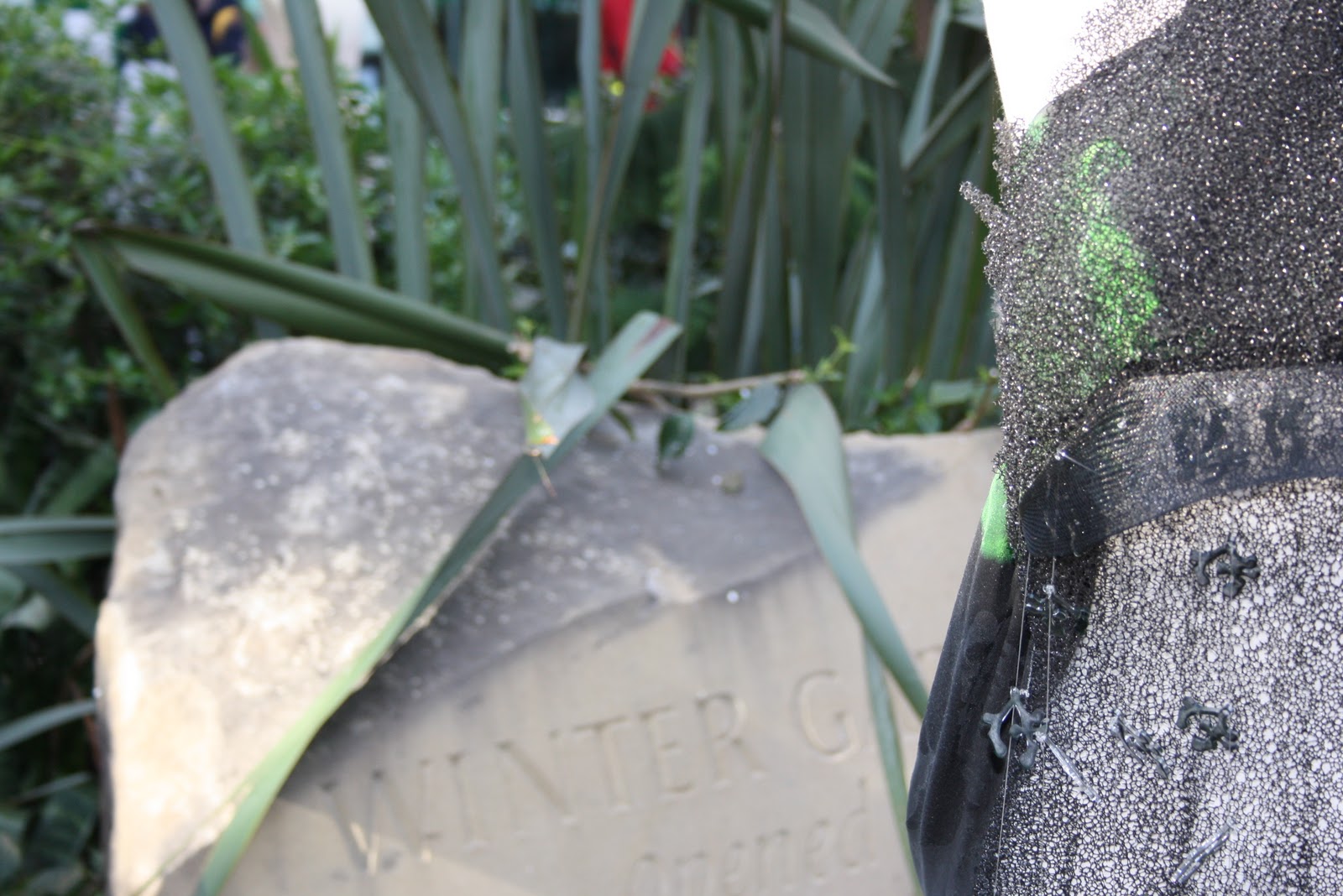
Well, if you stop by the Winter Gardens this month you can find out in a very unique, and beautiful, way. Primitive Streak is a 'science-art-fashion-collaboration' by sisters Kate and Helen Storey and it's found a temporary home in Sheffield's plant infested hotspot until March 10th.
The pair infused Helen's creativity and skill with Kate's professional scientific research and came up with the textile based collaboration. Since 1997 the collection has toured the world and enthralled audiences.
Walking around the dresses with Helen made the collection seem even more groundbreaking, I realised I'd never seen cell division made so explicit and so striking. Set upon an ivory shift dress, the process of anaphase is no longer a confusing, slimy scientific process but a corsage or brooch you wouldnt mind wearing on your tailored jacket. Similarly, fertilisation isn't an internal messy, sticky consequence of sex but a long delicately woven gown I'd quite happily don for a summer wedding. And suspended above the whole collection is a hat that, while embodying the formation of the heart, wouldn't look out of place at Ascot...or dare I say it, on the head of her Madge.
I'm completely taken by the exhibition and despite some of the dresses needing a bit of touching up in places, they are still as fascinating as the day they were made.
Find out more about Helen and Kate here:
Sunday, 13 February 2011
Exhibit C
Some of the images are from the past month, The Moor and its graffitied words of inspiration appear next to images of the city’s high rise buildings. There are photos of trams, famous buildings and the city’s people dating back to the early 70’s. All the photos are taken by those who know and love the Steel City and they help chart the changes across generations. The exhibition is part of the Facebook lead project ‘Pictures of Sheffield’ and was conceived by Hedley Bishop, who says that is ‘not an art project’, but I tend to disagree. Not only do some of the photographs stand out amongst the more amateur endeavours but the concept of displaying these gems in the grimy and often overlooked Co-op creates a strange juxtaposition of beauty and grim practicality.
Two photographs in particular that resonate behind the glass are an unnamed shot of the Madina or Wolseley Road Mosque and that of a Royal Mail postbox (more interesting than it sounds.)
The first shows the centre of worship in all its glory, with its emerald dome rising up amongst the red brickwork of the terraced houses around it. The colours are subtle yet stunning; Eastern opulence versus Northern grit.
The second caught my eye as soon as I approached the window, framed solidly it is on first glance a sharp shot of a Royal Mail Postbox, but the embossed ‘GR’ that features on the front of all of these beauties has been defaced by the clever addition of three letters, A N and Y. The word ‘ANGRY’ glares out from the scarlet paintwork of the pillar box. It’s an image that reminds us of past traumas the city has faced, most notably being at the centre of Maggie T’s tirade on the miners in the 80’s, but also captures a more recent sentiment felt by the city- betrayal by their own. Nick Clegg’s relationship with the city is beyond repair.
It’s a funny little display but it captures my attention every time I walk home. So, next time you’re down near Primark take a few more steps and have a gander.
http://www.facebook.com/#!/group.php?gid=25750519904&v=info
Monday, 24 January 2011
Literary Olympics
Whilst Danny Boyle slaves away on his plans for the 2012 Olympics opening ceremony, London ’s Globe Theatre has announced an altogether simpler, yet stunning idea. An Olympic Festival, with each one of Shakespeare’s 38 plays being performed in a different language.
Now, I’m a tad ashamed to admit this, but I actually felt a little frisson of excitement when I found this in the news. What could be better than Hamlet and all the ‘Next King of Denmark’ malarkey actually in Dutch? And Iago, the ego-centric villain of Othello, rambling through his vicious plans in Greek? And perhaps history’s most tragic love story being gasped and sighed through by Italian speaking actors? I’ll hedge my bets and say nothing is better than this.
I understand that this may not be, strictly-speaking, the reality of the situation. Clearly, some of the plays will have to be performed in a language that has nothing to do with their setting, plot or characters. But even this doesn’t put me off; personally I think The Tempest in Swahili would be simply lovely. However, whilst the romantics amongst us will probably get swept away in a tide of delight and duelling, I’m guessing that for some the thought of Shakespearian rhyming couplets in the playwrights own tongue sends shivers down the spine. Some people simply don’t get Shakespeare. And I do get why they don’t. Even people proficient in Shakespearian English can be foxed by some of his wordplay, puns and double-entendres. Some of it just doesn’t seem to make sense and it’s easy to get lost amongst the language and the multitude of lovers galloping across the stage. But this is a different argument altogether and one that deserves a dissertation worth of effort to discuss.
But the Globe’s idea is much easier to digest. What better way is there to symbolise the world coming together in one country, than bringing all the languages of the world together through the words of that country’s most eloquent poet and playwright.
Have a looksee on The Globe's website for more:
http://www.shakespeares-globe.org/
Have a looksee on The Globe's website for more:
http://www.shakespeares-globe.org/
Monday, 20 December 2010
Gimme Moore
The Millenium Galleries in Sheffield have pulled a couple of blinders this year. This summer's 'Watercolour in Britain' exhibition was a beautiful specimen to behold. I lost count of the lunch hours I spent gazing at the Pre-Raphaelite brotherhoods paintings. Rossetti, Hunt and Millais were peppered with some more contemporary peices, Chris Offili and Anish Kapoor standing out amongst the rest.
But this Autumn, they've shunted the Long Gallery around to make way for 'Restless Times: Art in Britain 1914-1945' an exhibition that in the curator's own words 'looks at the preoccupations of the period and draws parallels with today'. Having studied the Modern Period in the last term of my Literature degree I hoped I'd be able to put both the art and the literature into a wider historical context. This little (and slightly geeky) personal goal was a natural process when walking around the exhibition, helped along by the ridiculous ambitions of Wyndham Lewis and the Vorticists who wanted their fingers in every pie, and definately upped my appreciation of the work. The early 20th Century was wracked with political instability, technological progression, glamour, sin, rage, passion, anger and a crippling guilt at the abandonment of the past. T.S Eliot, Virginia Woolf and D.H Lawrence all embraced such contradictions with darkness looming over every line of their work.
The exhibition's Vorticist paintings helped put Modern Manifestos into practice. Blast is perhaps the most well-known of these, written in 1914 by Wyndham Lewis and Ezra Pound, the magazine's title meant the 'the blowing away of dead ideas and worn out notions'. This tirade on the past included the condemning of the French (their little trees causing the most frustration), Victorian London and all it represented; the suffragettes, the circus and codliver oil (really). If you ever have a spare minute, it's worth a look if only for its absurdity. Such frustration and forward looking is reflected in many of the works in Restless Times; mechanical shapes, vortexs of bold lines, dark colours permeated by bright reds and oranges all hint at modernisation and destruction at the same time.
But what gives the entire collection its weight is the few Henry Moore sketches that line one wall. Most of us know Henry Moore for his large, no massive, sculptures that are scattered around the country. But his finest work in my eyes is the series of sketches he made whilst in the Underground during the Blitz. The scratchy pencil, ink and charcoal drawings, sometimes illuminated by thin lines of colour, are exquisite. Somehow their beauty transcends the horror of the subject; rows upon rows of slumbering Londoners clinging to one another in the dark. Tender moments shared by men, women and children whilst they escape from noise and terror outside. The static, corpse-like appearance of the bodies suggesting the fine line of life and death of war-time existence. Despite suceeding TS Eliot's 'The Wasteland' by almost twenty years, the etchings of people in a brick walled wasteland encapsulate the sentiment behind his words: Unreal city,
Under the brown fog of a winter dawn,
A crowd flowed over London Bridge, so many,
I had not thought death had undone so many.
(Eliot, The Burial of the Dead, ll.60)
Despite this, I couldn't help but think that the exibition's curators had missed a trick. No doubt, the period was haunted, sandwiched between two world wars it was bound to be. But I missed the secret decadence of the Bloomsbury group that appears in so much of the literature, the international influences of absinthe and Africa, the revolutionary spirit. There was more underground than just the trains in this period.
The exhibitions on till January.*
*it's even suitable for the colour blind. Tried and tested.
Subscribe to:
Posts (Atom)